Verbal De-escalation at Self Defense Classes Condition 1 Combat Center
Most people search for a self defense class because something real nudged them. A tense exchange at a bar. A stranger who did not take no for an answer. The uneasy walk from the parking lot to the office door. What they need is not only how to throw a punch, they need to know what to say, how to stand, how to read the room, and when to leave. At Condition 1 Combat Center, verbal de-escalation is not a side note to the physical curriculum. It is integrated into how we warm up, how we spar, how we analyze risk, and how we decide what not to do.
Condition 1 Combat Center runs a full slate of programs. The mma gym environment builds athletes who can strike, clinch, and grapple. Our Brazilian Jiu Jitsu instruction focuses on control, positional dominance, and safe finishes. The muay thai program layers in distance management and clinch awareness. Boxing sharpens timing, head movement, and footwork. All of this supports self defense, but in an actual confrontation the first and best skill is the one that keeps you from throwing hands at all. That is where verbal de-escalation lives.
Why we teach words as seriously as punches
Violence is fast, messy, and expensive. Even if you dominate physically, you can lose legally, professionally, or psychologically. A short sentence said at the right moment can save months of headaches. We have taught hundreds of students who improved their lives by speaking more clearly under pressure.
I think of a recent student, a nurse on late shifts. She enrolled in our self defense classes after a scare in a parking garage. She learned basic striking and escapes, yes. The breakthrough came when she practiced a steady, rehearsed line delivered at the right volume, with the right body angle, while walking to her car. A week later a stranger approached, asking for a ride. She angled her body, kept a car length of space, and said, calmly, I cannot help you, please step back. She repeated it twice and moved to a better lit area. The interaction ended, not with a scramble on concrete, but with a decisive exit. That is success.
What verbal de-escalation actually involves
De-escalation is not just talking nicely. It is an integrated set of behaviors, starting with your eyes and feet and ending with your word choice. In our self defense classes at Condition 1 Combat Center, we break it down into usable elements that pair naturally with the physical skills from our mma training, BJJ, muay thai, and boxing sessions.
-
Stance and space. We use an interview stance that looks nonthreatening but mobile. Toes angled slightly off center, hands visible and relaxed between chest and waist, weight balanced to step back quickly. The body says I do not want trouble and I am paying attention. Our muay thai gym habits translate here. Students already know how to pivot and keep a safe range. The difference is cosmetic, palms open instead of fists, but the physics remain the same.
-
Voice and tone. Volume can escalate or de-escalate faster than profanity. A firm, clear statement with a neutral tone has more effect than a shout. This is where rounds on the heavy bag pay off. If you can control your breath after a minute of hooks, you can control it in a tense conversation.
-
Content and repetition. Short, specific sentences move people better than speeches. We teach boundary statements that can be looped. I cannot help you. Please step back. I do not want any problems. These are followed by an action, like moving laterally toward an exit.
-
Listening for hooks. Sometimes the quickest way to de-escalate is to give a person a face-saving exit. Hearing the emotion under their words, then reflecting it back in plain language, can break a cycle. You are frustrated. I hear you. I am not the one who can fix this. Let me get someone who can. This is not soft. It is strategic.
-
Exit and documentation. Leaving early beats winning late. Part of verbal de-escalation is knowing where to go and how to report what happened if needed. We include the basic after-action steps in our self defense classes, because memory under stress is unreliable and documentation supports you if things escalate later.
That framework lives inside every session. At the mma gym we might pair a punch defense drill with a boundary statement. In the boxing gym portion we pair jab footwork with de-escalation angles. During Brazilian Jiu Jitsu training we practice verbal commands to create compliance while breaking grips. The repetition builds automaticity.
How the combat sports support talking your way out
People sometimes ask why a place with cages, heavy bags, and wrestling mats spends so much time on words. The answer is simple. Real de-escalation only works if you have confidence that you can fight if you must. Predators sense weakness. Angry people push when they see fear. The physical foundation from mma training at Condition 1 Combat Center creates a calm baseline. From there, students can speak without trembling or overcompensating.
-
Boxing rhythm teaches cadence. A calm, even cadence tells a potential aggressor that you are under control. It also regulates your breathing, which reduces shakiness.
-
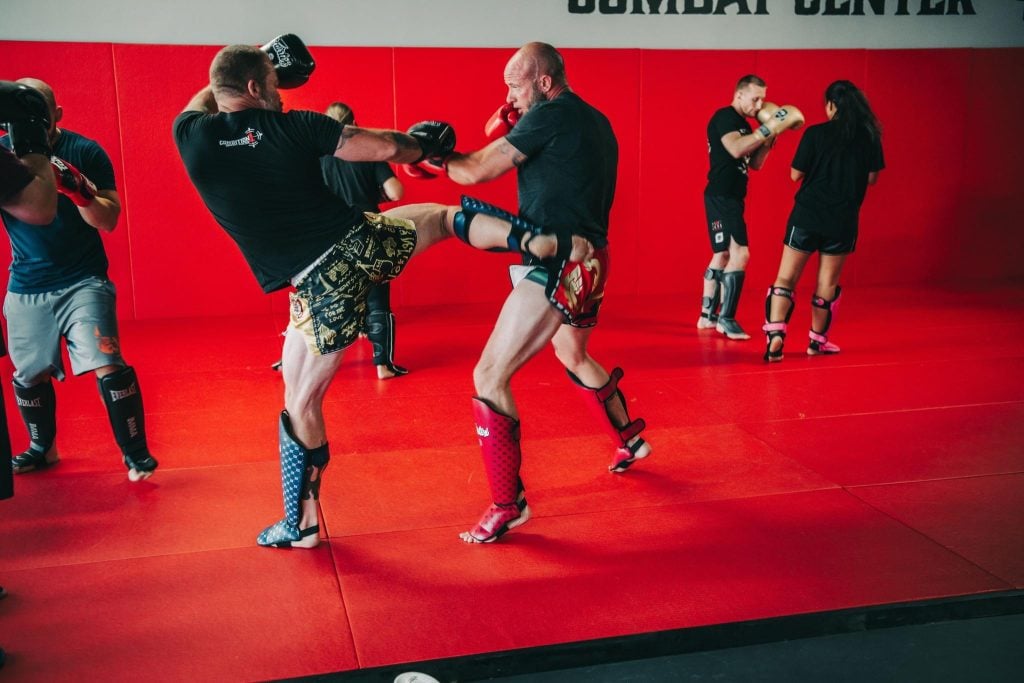
Muay Thai clinch work teaches posture under pressure. If someone crowds you, you already know how to frame, pummel for inside position, and create room without looking like you picked a fight.
-
Brazilian Jiu Jitsu gives you non-striking control. If you say I do not want problems, then someone grabs you, a simple two-on-one grip break and step back matches your words with action without damaging anyone.
-
MMA situational awareness forces you to track space, timing, and energy. On the street, that translates into seeing the friend circling your blind side, noting the curb behind your heel, and choosing to reposition before it matters.
At the Condition 1 Combat Center mma gym, we treat these overlaps as a design choice, not an accident. The head coach sets scenarios where students speak first, then move, then, only if needed, strike or grapple.
Scripts that work when stress fogs your brain
Under stress, complex words vanish. Students need phrases they can say without thinking. We encourage personalization, but a few scripts tend to work across many situations. These are not magic words. They are clean lines that do a job.
- I cannot help you. Please step back.
- I do not want any trouble. I am leaving now.
- That makes me uncomfortable. Stop and back up.
- I cannot fix this, but I can get someone who can.
- If you continue, I will call security and the police.
We practice these in the same way we practice combinations on pads. Students stand in the interview stance, make eye contact without hard staring, and deliver the line at conversational volume. A partner crowds, interrupts, or tries to lure them into debate. The task is to repeat the line twice, move, and disengage. During our self defense classes at Condition 1 Combat Center, the repetition creates a reliable groove so the words come out clean even when heart rate spikes.
What de-escalation looks like in real drills
Verbal skill is built like any other athletic skill. We stress the body, constrain choices, and force clear reps. In a typical class focused on de-escalation, you might see this progression.
We start with breath control and posture. Thirty seconds of shadow movement with open hands, elbows tucked, shoulders down. Coach calls for a phrase, students say it on the exhale. The room sounds steady, not loud. Then we add a partner whose only job is to invade space with different energies, from confused to aggressive. Students maintain angle and repeat a boundary statement. If the partner complies, students practice the exit. If the partner persists, they add a frame with the lead hand and small lateral steps, slipping to a safer line without shoving.
As the drill evolves, we insert a physical trap, like a wall on one side or a curb. The goal is not to win a debate, it is to move to a better position while keeping hands open and facial expression neutral. When someone grabs, the grappling skills trained during our brazilian jiu jitsu sessions take over, but we still ask students to speak. Let go of my arm. Back up. If the grip breaks and the person pauses, the student exits. If not, the student escalates to a simple, legally defensible control or strike and then moves.
On sparring days, we run short scenario rounds where the only way to score is to exit without contact. It is humbling for strong fighters to realize that an elderly receptionist can outscore them by speaking more effectively. That humility pays off later when the same fighter works door security on weekends and needs to escort out a patron without a brawl.
Special populations, tailored choices
Not every student has the same profile, so our verbal curriculum shifts accordingly. Kids need clear safety lines, not adult negotiation. Women often face boundary violations that are conversational in tone but coercive in effect, so we teach earlier, sharper lines. Service workers need scripts that align with company policy and state law.
For kids in our beginner classes we stick to five words or fewer. Stop. Back up. I need an adult. We train them to pivot, point, and move to a known safe spot, like a front desk or a coach on duty. We reinforce that they owe no one politeness when safety is at stake.
For women who want self defense without a combat sports deep dive, we build layers. A polite no, followed by a firm boundary if pressure continues. We coach body language that reads confident without inviting debate. During our bjj gym segments, women learn grip breaks focused on common wrist holds and hair grabs. We pair every mechanical skill with a phrase to keep bystanders on your side. Do not touch me. Back away. I am leaving.
For service staff, our self defense classes at Condition 1 Combat Center include role plays based on their actual job. A hotel clerk dealing with a guest trying to breach a staff only area. A rideshare driver managing an intoxicated rider. A bartender refusing service. We write scripts that reflect policy and local norms. We do not ask them to say anything that their manager would not back up.
Reading the person in front of you
Words are only half the picture. To de-escalate well, you need to read behavior in real time. Our coaches train students to notice small tells that predict violence or compliance. Over a month or two, most people sharpen this sense as much as they improve their jab.
Common signs that someone is moving toward violence include a sudden drop in conversational content, a fixed stare that shifts to scanning for witnesses, grooming gestures like rubbing the neck, blading their stance, or checking their waistband. On the other hand, people who are calming down tend to unfreeze their hands, breathe more audibly, and allow space to open between you. It is not foolproof, but the patterns show up consistently.
We simulate these tells in drills. An aggressor role player might rub their jaw and look past you, then turn their shoulder. Students respond by increasing distance and angling, even if they keep speaking. The link to mma training becomes obvious here. In the mma gym, one shift of a partner’s hip tells you the shot is coming. On the street, one shift of a stranger’s hip tells you to exit sooner.
Where the law and ethics meet your mouth
Any self defense curriculum that ignore legal and ethical context puts students at risk. Words can create clarity later if police or security get involved. We set baseline guidance at the start of our self defense classes.
Use simple, non-provocative language. Avoid insults, sarcasm, or taunts. Make your boundaries clear and specific. Pair words with movement toward safety, not with forward pressure. If witness statements follow, your recorded behavior reads as reasonable.
We also cover the right to disengage. You do not owe strangers a debate. If you say I am leaving now and walk, you are within your rights unless a specific duty requires you to remain. For staff like bouncers or security, we adapt scripts to match company policy and local law. A door staffer might say, Your tab is closed. Time to head out. If you do not leave, we will have to escort you. That is both a de-escalation and a legal foundation.
Documentation matters after the fact. If an incident rose to the level of calling police or supervisors, write a brief note with time, place, descriptions, and the exact boundary statements you used. It protects you.
Edge cases where words change, not vanish
Not every situation yields to calm talk. Intoxication, mental health episodes, group dynamics, or the presence of weapons shift the calculus. We train recognition and adjusted strategies during scenario nights.
An intoxicated person may not process complex sentences. We strip language down to verbs and actions. Stop. Sit. Wait. We slow our speech so they do not mirror our pace. Our stance opens more to avoid looking squared off, but our feet are ready to pivot and leave. If they cannot follow basic cues, words transition to protective positioning and exit.
Group confrontations require different boundaries. Talking to a group leader while ignoring the peanut gallery can collapse the group threat, but it can also draw heat. We teach students to avoid getting pinned in a circle. Choose a target line, speak once, and move decisively. A phrase like I am not part of this, I am leaving often buys enough pause to slip the net.
Suspected weapon presence triggers earlier disengagement. If someone continually checks their waistband or keeps a hand in a pocket while pressing closer, your words become shorter and your feet move sooner. In the boxing gym we train exits along the ropes when cornered. Those same angles help you leave a conversation toward a doorway or a more populated area. If you must act, you do so with purpose and without flashy moves. A simple frame, a low line kick to create space, then a run.
Building the skill over weeks, not just one seminar
De-escalation improves with discover more practice against live resistance. That is why a full program like the one at Condition 1 Combat Center, with consistent mma training and access to specialized self defense classes, outperforms a once a year seminar. We space exposure to scenarios, then revisit them after adding new physical tools.
Week one might focus on stance, space, and two script lines. Week two adds movement and simple grip breaks from our Brazilian Jiu Jitsu training. Week three brings in light contact, a shove against the wall followed by a clear command and exit. Week four layers environmental complexity like low light, noise, and a second role player who approaches from the side. By week eight, most students are making smart choices at speed, which is the whole point.
Our coaches track heart rate recovery after drills and note speech clarity under pressure. If a student’s words tangle when a partner gets loud, we turn down the volume and build back up. The same way we scale pad rounds in the boxing gym or pad kicks in the muay thai gym, we scale emotional intensity in conversation drills.

Where Condition 1 Combat Center’s community matters
The benefit of a strong community at the mma gym is that students can practice tough conversations with people they trust. Partners learn to push boundaries in role play without crossing real lines. After a scenario, feedback is specific. You looked down when you said no. Your words were clear, but you stayed in range. Move your feet sooner when you loop the line.
This culture grows because we emphasize respect in every class. In the BJJ gym sessions, a higher belt helps a newer student find a safer grip and a safer phrase. In muay thai classes, pad holders cue lines during footwork drills. In boxing, coaches make space for breath training between rounds and layer in verbal commands. The entire condition1combat.com ecosystem, from class signups to seminar announcements, supports this integrated approach. People come for mma training condition1combat.com advertises. They stay because they learn how to navigate hard moments outside the gym.
What a good self defense session feels like when words lead
A sample evening class could start with a ten minute warmup, shadow movement with open hands, side steps, and breath timing. Then, five minutes of script practice, students facing partners and matching eye level. We reset the room into lanes and run two minute scenarios. Each student faces three mini scenes: a boundary test from a stranger, a confused person blocking a doorway, and a heated argument over a parking space. Students must exit each without laying hands.
Next, we fold in physical safety nets. From the BJJ portion, a two-on-one wrist peel and a simple elbow frame. From boxing, an L step exit and a jab-hand post used not as a strike but as a spatial gauge. From muay thai, a collar tie to rotate out of a corner, hands open and voice steady. Back in scenario work, students try again. Most find their words become cleaner when their body has a plan.
We finish with a short after-action journal. Two lines each: what phrase worked, what moment felt sticky. This habit matters because it creates reflection and memory. A month later, when real life throws a curveball, those notes help.
Measuring progress without chasing perfection
Some people want a clean metric. How do you know de-escalation training works? The answer shows up in stories, not scores. Over a year, we hear dozens of student reports. A college student used a firm no and a sidestep to end an uncomfortable interaction on a bus stop bench. A father at a youth sports event defused a brewing parent argument by acknowledging frustration and inviting a pause. A bartender escorted a belligerent patron to the door with two calm lines and a clear walk. None of these made social media. They kept people out of trouble.
Inside the gym, we track a few proxies. The percentage of scenario reps where students exit without contact trends up over eight to twelve classes. The number of times students default to repeated louder words, rather than cleaner lines and movement, trends down. We see breath control improve through heart rate data captured by wearables during pad rounds. It is not perfect science, but it correlates with real world readiness.
How to adopt de-escalation habits outside the gym today
You can start applying pieces of this approach immediately. Choose a single line that fits your life and practice it in the mirror until it sounds like you. Rehearse saying it while you step to your left and glance for exits. Keep your hands visible and relaxed when you talk with strangers. Notice your breath in stressful meetings and aim for a steady five second inhale and seven second exhale right after you speak.
If you already train at an mma gym like Condition 1 Combat Center, ask your coach to layer a de-escalation cue into pad rounds. Between combinations, deliver a boundary statement while moving off line. In Brazilian Jiu Jitsu class, pair every grip break with a verbal cue. In muay thai, practice an open hand frame with a clear phrase, then pivot away. In the boxing gym, train an L step exit and a calm line as a set.
Over time, these habits stack. The goal is for your body and voice to work together, so strangers feel your boundary before you raise a fist.
Where to train this properly
Training verbal de-escalation inside a gym that also teaches legitimate fighting skills gives you options. At Condition 1 Combat Center you can enter through many doors. Some find us searching for an mma gym Condition 1 Combat Center on a browser. Others type condition1combat.com boxing gym or condition1combat.com bjj gym. Many ask about brazilian jiu jitsu training Condition 1 Combat Center because they want control without damage. Some come for the muay thai gym and stay because the de-escalation work made their daily life calmer.
Our self defense classes Condition 1 Combat Center offers run regularly. They are not theatrical. They are practical and coached by people who have managed conflict in the real world, from hospital corridors to bar entries to high school hallways. We like hearing your specific context so we can tailor drills. If you are a teacher, we build school hallway scenarios. If you ride the late train, we practice standing postures that work in tight cars. If you supervise teams, we practice how to say no firmly in an office without lighting a fuse.
One more story, because stories stick
A construction foreman joined the gym for stress relief and conditioning. He loved the boxing sessions, loathed the talk drills at first. After a month, he told us about a job site confrontation. A subcontractor arrived late, loud, and ready to argue. Before training, the foreman would have matched volume. That day he stood at a slight angle, hands visible, and said, not unkindly, I am not having this conversation like this. Step back and we can talk or head home, your call. He repeated it once. The other man ranted, then deflated. Work went on. No write ups, no lost production, no video drama on phones.
He did not shave points off his masculinity to do it. He used it better. Training made the difference, and not because he could outpunch the man. He outpaced the escalation entirely.
Final thoughts for serious students
Verbal de-escalation is a physical skill delivered through language. It is built from posture, breath, space, and timing, then expressed through short, clear lines. The punch, the choke, the kick, these are insurance policies you hope to never cash. The premium you pay is training. At an integrated facility like Condition 1 Combat Center, where mma training, BJJ, muay thai, and boxing live next to practical self defense classes, you can build those layers in the right order.
If you want to feel safer without becoming someone you are not, start with your voice. Train it, pair it with movement, and test it under pressure. The rest of your skill set will make those words land. And most days, that will be enough.